
Situated along the South China Sea coastline, Mukah occupies a crucial position in Sarawak’s future development. As the administrative, research, and human capital center of the Sarawak Corridor of Renewable Energy (SCORE), Mukah is driving the state’s industrial, agricultural, and technological evolution under the Regional Corridor Development Authority (RECODA) framework.
From the bustling lecture halls of its tertiary institutions to the sago processing belts along riverbanks and expanding industrial sites at Matadeng, Mukah is powered by steady, daytime activity. Meeting these operational demands cleanly and cost-effectively makes rooftop solar PV a strategic asset for the coastal division.
1. SCORE Growth Node & Knowledge Hub: Powering Campuses & Manufacturing
Mukah serves as the educational powerhouse and technical training engine for central Sarawak. Institutions such as UiTM Mukah, Politeknik Mukah, and CENTEXS Mukah prepare the region’s future workforce, while the nearby Matadeng Industrial Park hosts growing light manufacturing, logistics, and engineering operations.
SCORE DAYTIME ENERGY DEMAND
- Educational Campuses
- - Large-scale central air-con
- - Engineering labs & server rooms
- Matadeng Industrial Park
- - Light assembly & fabrication
- - Cold storage & warehousing
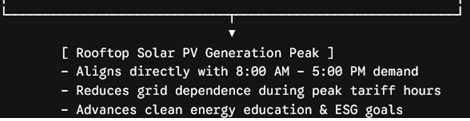
Educational campuses and industrial yards run at peak capacity during daylight hours 8AMto 5PM. Running central air-conditioning across lecture complexes, operating specialized technical labs, and maintaining climate-controlled server rooms creates substantial electricity loads.
Integrating rooftop solar across campus roofs and industrial facilities offers key advantages:
Direct Daytime Peak Shaving: Solar PV output aligns with daytime utility demand, directly cutting daytime energy bills.
Living Green Labs: Educational institutions turn their solar arrays into practical learning tools for students studying engineering, green tech, and renewable energy management.
Operational Margin Protection: Factories in Matadeng can maintain stable overhead costs despite expanding operations.
2. Sarawak’s SAGO Heartland & Coastal Agro-Food Industry
Mukah produces the majority of Sarawak’s sago. Across Tellian, Dalat, Oya, and Balingian, sago processing mills and food production centers operate alongside coastal fisheries and pineapple plantations.
DAYTIME AGRO-PROCESSING
- Sago Processing
- Mechanical rasping & starch extraction
- Cold-Chain Preservation
- Fish & seafood freezing for export markets
- Water Pumping Systems
- Riverine & aquaculture water management

Extracting sago starch—from mechanical trunk rasping to heavy sedimentation pumping and automated drying—requires uninterrupted power. Cold-chain storage for local seafood exports adds to continuous energy requirements.
Applying solar power to sago mills and agricultural processing plants provides:
Lower Processing Costs: Solar power offsets electricity consumption per tonne of starch or food processed, preserving operating margins.
Sustainable Produce Value: Using renewable energy enhances the sustainability profile of local exports, matching global demand for lower-carbon agricultural products.
3. Commercial Townships, New Airport & Coastal Trade
Commercial hubs across Mukah Town center, Mukah Waterfront, Medan Setia, and the Mukah New Airport area serve residents, industry workers, and visitors.
Shoplots, seafood restaurants, hotels, and retail outlets face high daytime power consumption driven by multi-split air-conditioning, display lighting, and commercial cooling.
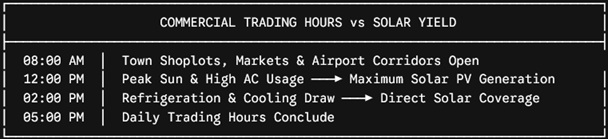
Rooftop solar PV serves as a reliable hedge against rising overheads:
Targeted Bill Reduction: Commercial electricity usage peaks during daylight hours, making solar energy a direct match for business energy needs.
Predictable Expenses: On-site solar power generation protects local business owners from unexpected operational cost increases.
4. Residential Lifestyle: Beating the Humid Coastal Heat
Mukah’s flat coastal geography along the South China Sea yields high daytime temperatures and humidity.
For lecturers, administrative personnel, technical staff, and families in Taman Setia, Kampung Tellian, Dalat, and nearby suburbs, running air conditioners through warm afternoons is often essential.
Unassisted daytime cooling can push household energy usage into higher utility pricing tiers:
THE SESCO BILL BUFFER
- Without Solar
- - Continuous midday air conditioning
- - Exceed 1,300kWh monthly baseline
- - Higher SESCO tariff rates applied
- With Solar
- - Abundant coastal sun powers cooling
- - Offsets daytime home electricity loads
- - Keeps consumption in lower-cost tiers
The SESCO “Bill Buffer”: Rooftop solar handles daytime air-conditioning loads as they occur. Generating your own electricity during hot afternoons keeps total grid power consumption below higher tariff thresholds 1,300 kWh.
Comfortable Living: Families can maintain a cool home environment without unexpected utility bill increases.
The Verdict: Solar Power for Mukah’s Coastal Future
Mukah’s development as a research, industrial, and agricultural center within SCORE relies on dependable infrastructure.
Rooftop solar PV offers a practical path to lower operating costs for educational campuses, increase margins for sago processors, support commercial traders, and maintain comfortable, energy-efficient homes.
As Mukah leads sustainable coastal development in Sarawak, rooftop solar provides the energy foundation to power that future.