If you live in Kuching, you know our daily relationship with the weather is… intense. We love our city’s vibrant food scene, the beautiful Sarawak River waterfront, and our laid-back pace of life. But we also know the daily battle against that familiar, heavy Kuching heat.
When big solar brands from Peninsular Malaysia or overseas try to sell solar panels, they usually throw around generic corporate speak about “saving the planet” or “calculating complex 20-year equity returns.”
But let’s be real. Kuchingites don’t live in a spreadsheet. We live in a tropical, rapidly growing city with its own unique climate, its own power grid (SESCO), and its own distinct economic hurdles.
When you look closely at how our city actually operates, it turns out Kuching isn’t just a good place for solar energy—it might actually be the most perfect playground for it in Malaysia. Here is why.
1. Geography & Climate: The “Guilt-Free Cooling” Reality
Let’s talk about the weather. Kuching sits almost right on the equator. That means we have highly stable, warm temperatures year-round, typically hovering between a balmy27°C and a sweltering 33°C. On average, we receive a solid 4 to 5 hours of peak, direct sunshine every single day.
But as any Kuchingite will tell you, it’s not just the heat—it’s the humidity.
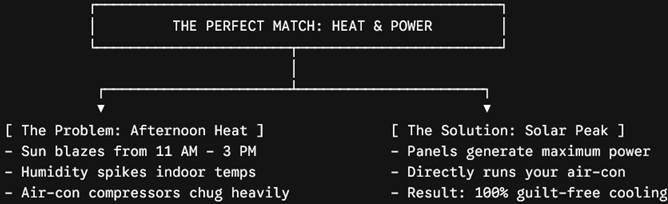
That heavy, humid afternoon air makes sitting in a room without air conditioning feel like a sauna. Our compressors chug away at maximum capacity right when the sun is at its highest, typically between 11:00am and 3:00pm.
Here is the beautiful geographic irony: The exact hours when you need air conditioning the most are the exact hours your solar panels are producing their absolute peak energy.
Instead of drawing expensive power from the grid to keep your living room cool, your roof acts as a direct shield. You are taking the very sun that is beating down on your roof and converting it instantly into crisp, cool, guilt-free air conditioning.
“But what about Landas season?”
It’s a fair question. Kuching is famous for its afternoon downpours and the wet monsoon season. But here is a bit of modern solar science: solar panels do not need blazing, direct sunlight to work. They run on daylight (ultraviolet light). Even on an overcast, rainy Kuching afternoon, modern photovoltaic panels still capture ambient light and generate power. Furthermore, the rain actually helps wash away accumulated dust from your panels, keeping them running at peak efficiency when the clouds part!
2. SESCO Tariffs: The Ultimate Bill Buffer
We are incredibly fortunate in Sarawak to have some of the most competitive electricity tariffs in Southeast Asia, thanks to Sarawak Energy (SESCO) and our abundance of clean hydropower.
However, SESCO uses a tiered tariff system. The more electricity you use, the more expensive every subsequent kilowatt-hour (kWh) becomes.
For middle and upper-income households in Kuching—especially those with growing families, home offices, or multiple air-con units—it is incredibly easy to cross the threshold into SESCO’s highest, most premium tariff bracket (anything over 1,300 kWh). Once you cross that line, your bill doesn’t just grow; it spikes.
This is where solar serves as a “Bill Buffer” rather than a mere financial speculation scheme:
Shaving the Peak: Solar panels offset your heavy daytime household baseload (refrigerators, washing machines, and daytime cooling).
Staying in the Safe Zone: By covering your daytime consumption, solar artificially “shrinks” the amount of power you pull from SESCO. This keeps your monthly grid usage safely below that expensive 1,300 kWh threshold, locked into the lower, highly subsidized tariff rates.
Instead of worrying about SESCO rate adjustments or micromanaging your family’s electricity usage, solar acts as a permanent, predictable buffer that secures your household running costs.
3. Shoplots, SMEs, and Demak Laut: Matching the Business Pulse
If you own a business in Kuching, you know that daytime overheads can quietly eat away at your hard-earned margins.
Whether you run a bustling cafe in Galacity, a retail shoplot in Metrocity, or a light manufacturing facility in the Demak Laut Industrial Park, your operational hours likely follow a strict schedule: 9am to 5pm

This 9-to-5 window is a flawless, 1-to-1 match with solar energy production.
Direct Consumption: Unlike residential homes where people are often away at work during the day, a business uses its maximum electricity while the sun is shining. Every light bulb, commercial refrigerator, POS system, and office air-con is powered directly by the roof in real-time.
Commercial Protection: Cold storage facilities, local food processors, and bakeries in Kuching carry incredibly high, non-negotiable daytime power loads. Using solar protects these local SMEs from commercial demand charges and provides flat, predictable operating costs for decades to come.
4. The “Green Sarawak” Vision: Be Part of Kuching’s Future
There is a massive, exciting shift happening right under our feet. Under the Sarawak Government’s Post-COVID-19 Development Strategy (PCDS) 2030, our state is actively transforming into the green energy capital of Southeast Asia.
From the upcoming Autonomous Rapid Transit (ART) system gliding through Kuching’s streets to cutting-edge hydrogen production facilities, our city is rapidly decarbonizing.
Installing solar on your home or business isn’t just an individual choice; it aligns you directly with this historic state-wide transition. By generating your own clean power on your roof, you ease the load on our local urban grid, reduce the need for localized fossil-fuel peaking plants, and proudly play an active role in making Kuching a clean, sustainable city for the next generation.
The Verdict
It is time to stop thinking of solar panels as a complicated, volatile financial stock.
In Kuching, solar is simply a practical, modern appliance for comfortable living. It matches our weather, buffers us against premium SESCO rates, aligns perfectly with our daytime business hours, and powers our city’s green future.
So, let’s stop staring at theoretical spreadsheets. If you are ready to stop letting the midday Kuching heat dictate your monthly budget, it’s time to look up at your roof and unlock its true potential.